What Is the Best Warehouse Storage System in 2026?
Choosing the best Warehouse Storage system in 2026 is less about finding one winning product and more about matching equipment to daily work. A small parts operation may benefit from shelving and clearly labeled bins. A high-volume distribution center might need selective pallet racking, drive-in racks, or automated storage. The right fit depends on inventory size, product turnover, available floor space, handling equipment, and plans for growth.
Small details matter. A forklift aisle that is too narrow can slow replenishment. A fast-moving carton stored above shoulder height can add unnecessary handling time. Before comparing systems, review item dimensions, pallet loads, order patterns, and the building’s clear height. Safety, access, and inventory visibility should shape the decision alongside storage capacity. More density is not always better.
It depends.
This guide examines common warehouse storage options, including their strengths, limitations, and suitable applications. It also considers costs beyond the initial purchase, such as installation, maintenance, and changes to operating workflows. Specifications and site conditions vary, so any recommendation should be checked against actual loads and facility measurements. A system that looks efficient in a catalog may not work smoothly during a busy shift. That is worth questioning early. By comparing practical trade-offs rather than chasing a single “best” answer, warehouse teams can make a more informed choice for 2026 and beyond.
What Warehouse Storage Systems Are and How They Work
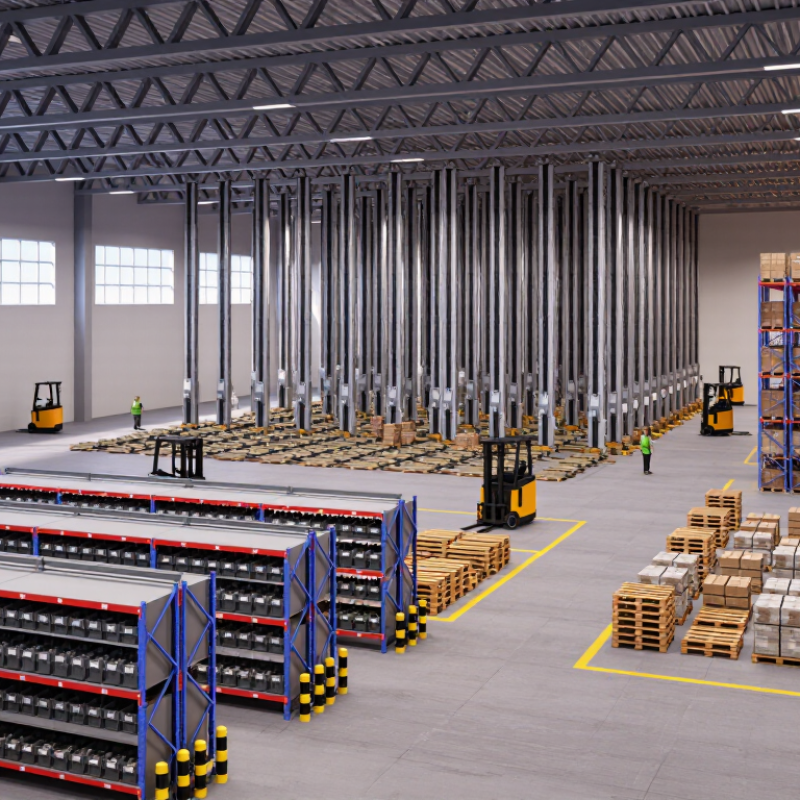
A warehouse storage system is the physical setup that holds goods and helps workers retrieve them. It may combine pallet racks, shelving, bins, and automated storage equipment. A warehouse management system tracks locations and inventory; it is software, not a rack. Together, these tools shape how products move from receiving docks to storage, picking, and dispatch.
In a selective rack, a forklift places a pallet into a chosen location, keeping many items directly accessible. Higher-density systems reduce aisle space but can make some goods harder to reach. Automated systems use cranes or shuttles to store and retrieve loads, often following instructions from inventory software.
Workers still need clear labels, safe loading practices, and accurate stock records. Aisle labels still get missed. Small errors can send a picker to the wrong bay.
The choice depends on product size, turnover, available floor space, and how quickly orders must be filled. MHI’s 2023 Annual Industry Report found that 74% of surveyed organizations expected to adopt robotics and automation within five years. That figure reflects expectations, not guaranteed results for every warehouse. MHI and Deloitte’s 2024 Annual Industry Report also reported that 55% of respondents planned to increase supply-chain technology investment. Neither statistic proves that automation suits every operation. A slow-moving, bulky product may need simple, accessible storage more than a fast machine.
Which Factors Determine the Best System for a Warehouse in 2026?
The best warehouse storage system in 2026 depends on the work it must support, not on a single trend. Start with the inventory: record each item’s dimensions, weight, turnover rate, and storage conditions. Fast-moving cartons near packing stations may need a different setup from slow-moving, bulky products. Space matters. Measure clear ceiling height, aisle width, floor capacity, and obstacles such as sprinkler pipes. A tall rack can look efficient on paper but may be unsuitable for the building or the equipment that serves it.
Daily movement is just as important. Review order lines per hour, peak-season volume, picking methods, and the distance workers travel. Selective shelving can offer direct access to many product types, while denser systems may suit goods with fewer access requirements. There is a trade-off. Higher storage density can reduce travel space or make individual items harder to reach. Storage decisions should also match forklifts, conveyors, or planned automation, rather than assuming new equipment will solve an awkward layout.
Reliable data helps, but it cannot replace observation. Walk the floor during a busy shift and note queues, blocked aisles, and repeated handling. A common mistake is designing for average demand alone; seasonal peaks can expose weak points quickly. Compare installation, maintenance, labor, and expansion costs over time. Then test the proposed layout with real inventory and order patterns. Some assumptions will be wrong. That is useful to discover before the racks are installed.
What Is the Best Warehouse Storage System in 2026?
Key factors to evaluate when selecting a warehouse storage system
The best system depends on the operation’s SKU mix, inventory turnover, available space, handling equipment, and budget. Ratings are illustrative planning priorities on a 1–5 scale, not measured industry data; adjust them to your warehouse’s requirements.
What Types of Warehouse Storage Systems Are Available?
Warehouse storage systems range from simple shelving to high-density automated installations. Selective pallet racks give forklifts direct access to each pallet, making them useful when inventory changes often. They are easy to adjust, though aisle space can limit total capacity.
For dense storage, drive-in racks let forklifts enter the structure and place pallets several positions deep. Push-back racks use inclined carts, while pallet-flow racks move loads forward with gravity. Both can store many pallets per product, but they suit different turnover patterns. Flow lanes work well when older stock should leave first. Drive-in systems need more careful forklift operation. Small details matter.
Cantilever racks hold long or awkward items, such as timber, pipes, or metal sections. Shelving suits cartons and hand-picked goods, while mezzanines add usable levels above an existing floor. Automated storage and retrieval systems can handle compact, repetitive movements with less manual travel. They also require careful planning and skilled maintenance. A tidy drawing can still miss a real bottleneck.
The right system depends on pallet dimensions, item variety, picking speed, ceiling height, and handling equipment. I would measure actual loads and observe a busy shift before choosing. A layout that looks efficient on paper may feel cramped when two forklifts meet. It happens.
How Do Storage Systems Compare in Capacity, Access, and Cost?
Warehouse storage choices trade space against access and investment. Selective pallet racking gives workers direct access to every pallet and usually requires less specialized equipment. The trade-off is wider aisles and lower storage density. Double-deep racking stores more pallets in the same footprint, but operators need suitable reach trucks, and the rear pallet is less accessible. Drive-in systems can use space efficiently for large batches of similar stock. They also limit selectivity, so a misplaced assumption about turnover can create delays.
Automation changes the calculation. MHI’s 2023 Annual Industry Report found that 74% of respondents expected to adopt robotics and automation within five years. That signals growing interest, not guaranteed savings. Automated storage and retrieval systems can reduce travel and reclaim floor space, but equipment, software, maintenance, and integration raise upfront costs. Labor remains part of the equation: the U.S. Bureau of Labor Statistics reported a $17.92 median hourly wage for hand material movers in May 2023. Actual staffing costs vary by location and shift. Measure peak inventory, pallet dimensions, order frequency, and access needs before comparing quotes. A dense layout looks impressive. It may still be wrong for fast-moving, mixed stock.
What Is the Best Warehouse Storage System in 2026? — How Do Storage Systems Compare in Capacity, Access, and Cost?
| Storage system | Capacity and space use | Access and stock rotation | Typical relative cost | Best suited to | Main trade-off |
|---|---|---|---|---|---|
| Selective pallet racking | Low to medium storage density; requires an aisle for each rack row. | Direct access to every pallet; supports FIFO or LIFO depending on operating procedures. | Low | Warehouses with many SKUs, varied inventory, or frequent picking. | Excellent selectivity, but aisle space limits the number of pallet positions. |
| Double-deep racking | Medium density; stores pallets two positions deep and generally reduces the number of access aisles. | Two-deep access; the rear pallet is less directly accessible and typically requires a suitable reach truck. | Low to moderate | Operations with multiple pallets per SKU and moderate turnover. | More positions than selective racking, with lower selectivity and additional equipment requirements. |
| Drive-in racking | High density; forklifts enter storage lanes, reducing the need for access aisles. | Usually LIFO within each lane; access is lane-based rather than pallet-by-pallet. | Moderate | Large quantities of a small number of SKUs, especially where storage density is a priority. | Lower selectivity and greater risk of disrupting stored loads during handling. |
| Push-back racking | High density; commonly configured several pallet positions deep per lane. | Typically LIFO; loading and retrieval take place from the same aisle. | Moderate to high | Medium-turnover products stored in multiple-pallet quantities by SKU. | Higher system cost than basic selective racking, with limited access to individual pallets deep in a lane. |
| Pallet flow racking | High density; inclined roller lanes use gravity to move pallets toward the picking face. | Typically FIFO, with loading and picking on opposite sides of the rack. | High | High-turnover goods, date-sensitive inventory, and operations requiring stock rotation. | Higher installation and maintenance costs; pallets and loads must be suitable for flow lanes. |
| Mobile pallet racking | High space utilization; rack rows move to open a shared access aisle. | Direct access to the selected row after an aisle is opened; access is sequential rather than simultaneous. | High | Facilities with limited floor area, lower-to-moderate picking frequency, or costly building space. | Access can be slower, and the system needs powered movement equipment and safety controls. |
| Automated storage and retrieval system (AS/RS) | Potentially very high density; can use building height and narrow aisles, subject to design and building constraints. | Computer-controlled storage and retrieval; throughput depends on equipment, layout, and order profile. | Very high | High-volume operations with predictable processes, significant labor constraints, or a need for controlled inventory handling. | High capital and integration costs; requires suitable infrastructure, maintenance, and automation expertise. |
| Cantilever racking | Capacity is configured for long or irregular loads rather than standard pallet positions. | Open-front access to stored items; handling usually uses a forklift or other suitable equipment. | Low to moderate | Long, bulky, or awkward goods such as lumber, pipe, and sheet materials. | Not designed to maximize storage of standard palletized goods. |
Cost guide: Relative cost levels are indicative, not quoted prices. Actual installed cost depends on building height and condition, seismic requirements, load specifications, material handling equipment, fire protection, automation, and local labor rates. The best system depends on SKU count, inventory turnover, required selectivity, available space, and budget.
How Can a Warehouse Choose and Implement the Right System?
Choosing a warehouse storage system starts with the work, not the catalog. Map SKU velocity, order profiles, load dimensions, aisle widths, and clear height. Measure the real flow. Fast-moving cartons may suit flow shelving near packing, while slower pallet loads may need selective racks. High-density storage can save floor space, but it may reduce direct access. Peak demand matters more than an average Tuesday.
MHI’s 2024 Annual Industry Report found that 55% of surveyed organizations planned to increase supply-chain technology investment within two years, and 88% viewed innovation as a competitive advantage. Those figures support investment, not automatic purchasing. Compare options against measurable needs: picks per hour, replenishment travel, usable capacity, and safe load limits. Then test a small zone with representative products. Track congestion and mis-picks, too. The pilot may expose an awkward truth: a neat layout can slow replenishment.
Before rollout, check floor conditions, sprinkler clearance, equipment routes, and staff workflows with qualified professionals. Confirm that inventory software can represent locations and replenishment rules accurately. Train a shift team, document exceptions, and review results after several busy weeks. Leave room to adjust. Some assumptions will be wrong.
Related Posts
-
Why Is Warehouse Storage Important for Global Buyers?
-
China Top Storage Racking Systems Manufacturers?
-
How to Choose Industrial Racking in 2026?
-
Understanding the Benefits of Pallet Rack Shelving for Your Warehouse Efficiency
-
2026 Top Pallet Racking Systems for Warehouses
-
How to Choose the Best Warehouse Pallet Racking System?