




Why Choose Silicon Nitride for Industrial Applications?
Why Choose Silicon Nitride for Industrial Applications?
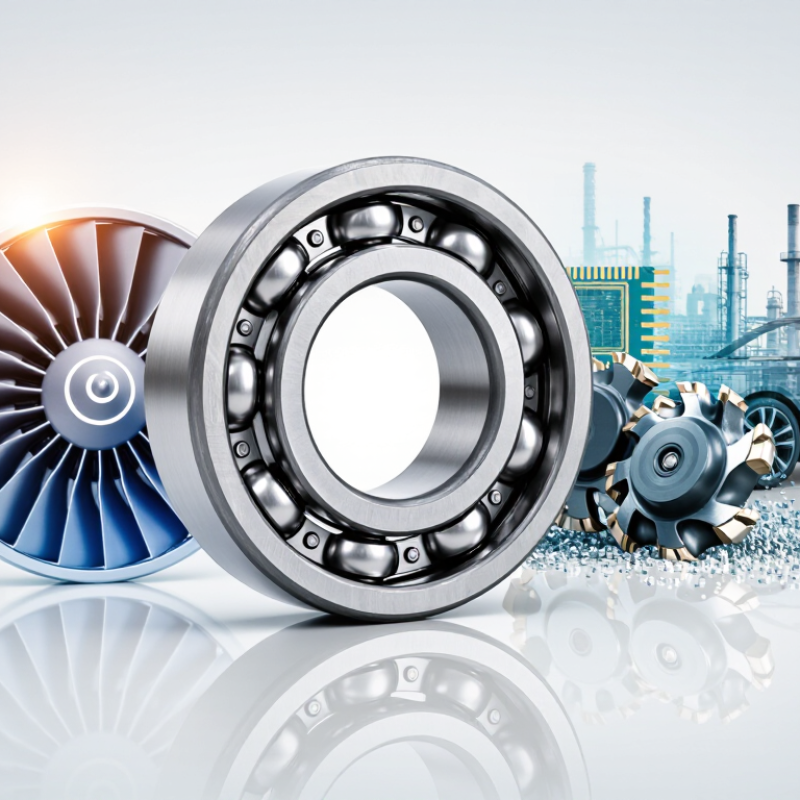
Silicon Nitride is gaining attention where metals and conventional ceramics reach their limits. Its low density, high hardness, thermal-shock resistance, and strong wear performance support demanding industrial designs. Bearings can run with less lubrication. Turbine components can face rapid temperature changes. Cutting tools can retain their edges under severe friction. These benefits are especially valuable in aerospace, automotive, energy, semiconductor, and chemical-processing equipment.
Industry data supports this momentum, although market estimates vary. Grand View Research reported continued growth in the global silicon nitride ceramics market through 2024, driven by advanced bearings, engine components, and electronic substrates. Fortune Business Insights also identified automotive electrification and semiconductor production as major demand factors in its technical ceramics analysis. The International Energy Agency’s Global EV Outlook 2024 further recorded strong electric-vehicle growth, creating opportunities for durable, electrically insulating ceramic components. Numbers differ between reports. That difference deserves careful attention.
Dr. Yutai Katoh, a leading ceramic materials researcher at Oak Ridge National Laboratory, has stated, “Silicon nitride offers an unusual combination of strength, toughness, and high-temperature stability.” This combination explains its industrial appeal. However, Silicon Nitride is not a universal replacement material. Manufacturing costs, machining difficulty, porosity control, and joining methods can limit adoption. Engineers must examine the full lifecycle, not only laboratory strength. A component that survives a hot test may still fail during installation or maintenance. Practical experience matters. So does honest testing.
What Is Silicon Nitride and How Is It Made?
Why Choose Silicon Nitride for Industrial Applications?
What Is Silicon Nitride and How Is It Made?
Silicon nitride is a technical ceramic made from silicon and nitrogen. Its chemical formula is Si₃N₄. Strong covalent bonds give it high hardness, low density, and excellent thermal stability. It also resists wear, corrosion, and sudden temperature changes.
Manufacturing usually begins with carefully selected silicon powder. Producers may use direct nitridation, carbothermal reduction, or chemical vapor deposition. During direct nitridation, silicon reacts with nitrogen at elevated temperatures. The resulting powder is milled, classified, and mixed with controlled additives. These steps influence strength and dimensional accuracy.
The powder then becomes a part through pressing, injection molding, or slip casting. Sintering follows in a nitrogen-controlled furnace. Heat removes porosity and develops the final ceramic structure. Some components receive hot isostatic pressing for improved density and reliability. Small changes in powder size or furnace temperature can affect performance. Processing changes everything.
It is not flawless. Silicon nitride can be costly to machine after sintering, and poor handling may create hidden defects. Engineers therefore inspect surfaces, measure density, and test parts under realistic loads. In bearings, seals, cutting tools, and high-temperature components, the material’s value depends on proper design and disciplined processing. A strong ceramic still needs careful engineering.
Why Choose Silicon Nitride for Industrial Applications? - What Is Silicon Nitride and How Is It Made?
| Category | Data Dimension | Typical Silicon Nitride Information | Industrial Relevance |
|---|---|---|---|
| Material Profile | Chemical formula | Si3N4 | A covalent ceramic composed of silicon and nitrogen. |
| Color and appearance | Typically gray to dark gray; surface finish depends on processing. | Suitable for precision components where dimensional stability and surface quality matter. | |
| Density | Approximately 3.1–3.3 g/cm³, depending on grade and porosity. | Lower density than many engineering metals, helping reduce rotating and moving mass. | |
| Room-temperature hardness | Typically about 14–18 GPa Vickers hardness. | Provides strong resistance to abrasion, erosion, and scratching. | |
| Fracture toughness | Common engineering grades are approximately 5–8 MPa·m1/2. | Higher damage tolerance than many traditional technical ceramics, although it remains brittle compared with metals. | |
| Elastic modulus | Approximately 280–320 GPa. | High stiffness supports accurate operation under mechanical loads. | |
| Thermal and Electrical Performance | Maximum service temperature | Often used continuously at temperatures around 1,000–1,200°C in suitable atmospheres; exact limits depend on grade, load, and environment. | Retains useful strength and stability in demanding thermal processes. |
| Thermal conductivity | Approximately 15–35 W/m·K, depending on composition and microstructure. | Helps dissipate heat more effectively than many oxide ceramics. | |
| Coefficient of thermal expansion | Approximately 2.5–3.5 × 10⁻⁶/K. | Low expansion reduces dimensional change and thermal-mismatch stress. | |
| Electrical resistivity | Generally high at room temperature; exact values vary with purity, additives, and temperature. | Combines electrical insulation with mechanical strength and thermal capability. | |
| Thermal shock resistance | Generally good because of its low thermal expansion and useful thermal conductivity. | Suitable for components exposed to rapid heating and cooling cycles. | |
| How It Is Made | Raw material preparation | High-purity silicon powder and nitrogen-containing feedstocks are selected, milled, and blended with sintering additives when required. | Powder quality and additive control influence density, strength, and final microstructure. |
| Powder synthesis | Silicon powder may be reacted with nitrogen at elevated temperature to form silicon nitride powder. | Controls phase composition, particle size, purity, and suitability for forming. | |
| Shaping | Common methods include dry pressing, isostatic pressing, injection molding, extrusion, and slip casting. | The method is selected according to geometry, tolerances, production volume, and tooling requirements. | |
| Densification and finishing | Sintering may use pressureless sintering, gas-pressure sintering, reaction bonding, or hot pressing; grinding and polishing are used for precision surfaces. | Densification improves strength and reliability, while diamond-based machining can achieve tight tolerances. | |
| Industrial Applications | Bearings and rolling elements | Ceramic balls and hybrid bearing components. | Low density, wear resistance, electrical insulation, and corrosion resistance can support high-speed or electrically demanding systems. |
| Cutting tools and wear parts | Cutting inserts, guides, nozzles, seals, and pump or valve components. | High hardness and resistance to thermal shock help in abrasive or high-temperature service. | |
| Automotive and energy systems | Ignition components, engine-related parts, seals, and components for high-temperature energy equipment. | Maintains performance under heat, friction, chemical exposure, and cyclic loading. | |
| Semiconductor and electronics equipment | Wafer-handling parts, heater components, insulators, and process fixtures. | High-purity grades offer dimensional stability, electrical insulation, and resistance to thermal cycling. | |
| Aerospace and defense systems | Lightweight structural, thermal-management, and wear-resistant ceramic components. | The combination of low density, stiffness, thermal stability, and damage tolerance can reduce mass while maintaining performance. |
Note: Property values are representative ranges for engineering silicon nitride and vary with composition, porosity, processing route, test method, and operating environment.