China Best Wholesale Home Theater Seats Suppliers?
Choosing China’s best suppliers of Wholesale Home Theater Seats takes more than comparing catalog photos and unit prices. Buyers should examine frame construction, reclining mechanisms, upholstery options, customization capacity, and replacement-part support. A chair may look impressive under showroom lighting. The stitching and mechanism tell a fuller story.
Designer Charles Eames famously said, “The details are not the details. They make the design.” That principle applies to theater seating, where quiet recliners, smooth footrests, firm seams, and well-placed cupholders shape the daily experience. Ask suppliers for material specifications, product samples, production timelines, and clear warranty terms. Ask for proof. A sample can reveal comfort and finish, but it cannot prove every production run will match.
This guide explores how to assess Chinese manufacturers, compare wholesale offers, and check communication before placing a bulk order. It also considers practical details such as minimum order quantities, packaging, shipping arrangements, and after-sales service. A low quote can be tempting. It may not include the support you need. I would not treat polished product photos as evidence of consistent quality; that is an easy mistake, and one worth questioning. The right supplier is not always the cheapest. It is the partner whose claims, samples, and process hold up under careful review.
What Defines a Wholesale Home Theater Seat Supplier in China?
A wholesale home theater seat supplier in China serves more than a one-time order. It should explain its production capacity, materials, customization options, and shipping process clearly. Buyers can ask for seat dimensions, upholstery samples, foam specifications, and a written quotation. Details matter.
A reliable supplier can describe how frames are assembled and how each order is checked before packing. Ask whether the team can share inspection records or current production photos. For larger projects, confirm carton sizes, loading plans, lead times, and replacement-part availability. A polished showroom is useful, but it does not prove consistent production. Verify the details.
Customization may include reclining mechanisms, cup holders, stitching, and row layouts. Get approved drawings or a sample before confirming a bulk order, especially when room measurements are tight. Clarify which changes affect price or delivery time. Communication is part of quality. Slow, vague answers can become costly when specifications change. Even experienced buyers can miss small details, so keep requirements in writing and review them before production begins.
Key Features and Materials of Home Theater Seating
Home theater seating should balance posture, movement, and easy cleaning. Grand View Research’s 2023 global furniture market report estimated the sector at USD 736.18 billion. That broad figure is context, not seating-specific evidence. When comparing wholesale models, request foam-density details, seat-load ratings, and mechanism-cycle test records. Do not rely on “high-density” labels alone. Steel frames can handle repeated movement when joints and fasteners are well designed. Plywood can reduce weight, but edge sealing and screw retention matter. Feel matters.
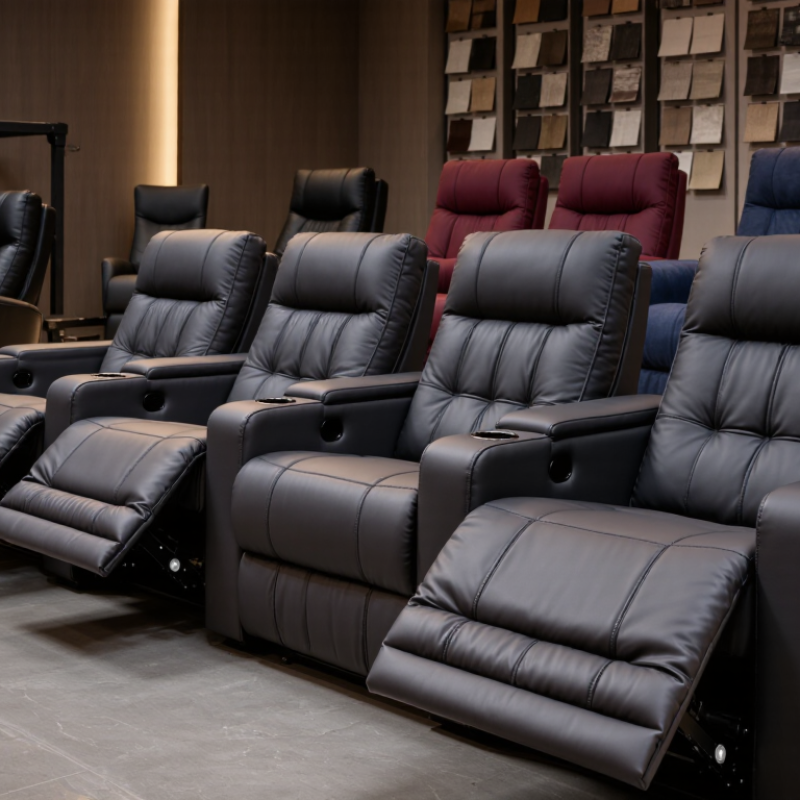
Upholstery affects comfort as much as appearance. Leather offers a natural surface, while polyurethane and PVC are wipe-clean options; check heat buildup and cracking resistance. Woven polyester and performance blends may feel more breathable, though textured yarns can trap stains. Ask for abrasion and colorfastness test results, plus clear care instructions. Then inspect seams. In a sample room, recline fully, check armrest height, and listen for mechanism noise. A plush seat may feel inviting for ten minutes, then flatten during a long film. Request a production sample and verify dimensions, stitching, foam feel, and finish consistency before approving a large order.
How to Assess Chinese Suppliers for Quality and Reliability
When comparing Chinese wholesale home theater seat suppliers, judge the factory by repeatable evidence, not polished photos. Ask for a specification sheet covering frame material, foam density, upholstery type, recliner mechanism, and load rating. Details matter. Request a pre-production sample, then check seams, armrest alignment, footrest movement, and gaps after repeated operation.
Reliable suppliers can explain how they inspect incoming materials and finished seats. Ask to see dated inspection records, defect limits, and corrective-action examples, with customer details removed. For a powered model, confirm the motor and controls are tested under load; for manual recliners, inspect smooth movement and locking. Also check whether packaging protects corners and moving parts during a trial shipment.
Communication is part of quality. Compare written answers on lead times, replacement parts, warranty coverage, and approval of production changes. Check that the stated factory address matches its business documents, and request a video walkthrough or independent inspection when practical. One good sample does not prove consistency; verify a later production batch too. Stay specific. Some checks may still miss problems.
How to Assess Chinese Home Theater Seat Suppliers
Suggested evaluation weights for comparing suppliers. These are buyer-defined priorities, not industry averages or supplier performance data.
How to use it: Request quality records and product inspection results; verify seat dimensions, mechanisms, upholstery, and any market-specific safety requirements; then compare delivery history, customization capability, communication, and after-sales terms. Adjust the weights to fit your project.
Comparing Customization, Pricing, and Minimum Order Requirements
When comparing China-based wholesale suppliers of home theater seats, look beyond fabric swatches. Customization may include seat width, reclining mechanisms, cup holders, stitching, and power controls. Ask for a written specification sheet and a sample of the upholstery. A small detail, such as the location of a USB port, can affect comfort and installation. Measure twice.
Pricing depends on more than the frame and upholstery. Request separate costs for customization, packaging, and shipping, and confirm which items are included in the quote. Compare identical specifications across suppliers; otherwise, a lower price may simply reflect thinner foam or fewer features. Ask whether prices change with order volume, and how long the quote remains valid. I would not treat the cheapest offer as the best value. That sounds obvious, yet it is easy to overlook when budgets are tight.
Minimum order quantities vary with the design and production schedule. A standard model may allow a smaller trial order, while custom colors or dimensions can require more units. Confirm the minimum for each configuration, not just the headline figure. Also ask whether mixed models count toward one order and whether replacement parts can be purchased separately. A modest sample run can reveal issues with stitching or reclining motion, though it may cost more per seat. Not every supplier makes this process easy. That is useful to know before paying a deposit.
Steps for Verifying and Selecting a Suitable Supplier
Selecting a wholesale home theater seat supplier starts with evidence, not a polished catalog. Request the company’s business details, production address, and a live video walkthrough of its workshop. Compare these with the quotation and product documents. Ask how many seats it can produce monthly, and whether upholstery, stitching, and frame assembly are handled in-house.
Check a sample in person when possible. Measure seat width, armrest height, and the distance needed for full recline. Test the mechanism several times, and inspect seams, exposed staples, and gaps around moving parts. Ask for written specifications on frame materials, foam density, weight capacity, packaging, and spare-part availability. Ask for proof. A brief sample test cannot predict years of use, but it can reveal loose stitching or noisy hardware early.
Request a detailed quote that separates unit price, sample fees, minimum order, production time, and shipping terms. Contact two or three trade references, and ask about delays or replacement parts—not only product quality. A spreadsheet helps, but it can create false confidence when every supplier uses different specifications. Clarify any vague figures in writing, then confirm agreed details before paying a deposit. Even careful checks have limits; a remote inspection may miss issues that appear during bulk production, so agree on inspection points before manufacturing begins.