

China Indoor Trampoline Park Design Manufacturer?
Choosing a China Indoor Trampoline Park Design Manufacturer requires more than attractive computer renderings. A successful park must combine excitement, safety, durability, and efficient use of space. Indoor Trampoline Park Design Manufacturing brings these demands into one coordinated process. Experienced teams study the building’s ceiling height, floor condition, entrances, emergency routes, and visitor flow. They then develop zones for trampolines, foam pits, climbing elements, dodgeball, and quiet waiting areas. Small measurement errors can create expensive problems later.
Professional manufacturers should support their proposals with practical engineering knowledge. They may provide CAD drawings, load calculations, material specifications, installation guidance, and maintenance recommendations. Good communication matters too. The client should understand why each steel frame, cushion, net, and anchor is selected. Clear documentation builds trust. So does a realistic production schedule. Ask for project references, factory information, quality records, and evidence of completed installations. Photos alone are not enough.
Not every low-cost offer is truly economical. Some quotes exclude installation, replacement parts, testing, or future adjustments. That is where careful comparison becomes valuable. No design is perfect. Even experienced teams can overlook cleaning access, staff visibility, or changing customer behavior. A reliable partner welcomes questions and revises weak details before production begins. This guide explores how to evaluate Chinese manufacturers through design capability, manufacturing control, safety planning, customization, communication, and after-sales service. The goal is simple: create an engaging trampoline park that performs well, ages responsibly, and gives operators confidence every day.
What Is a China Indoor Trampoline Park Design Manufacturer?
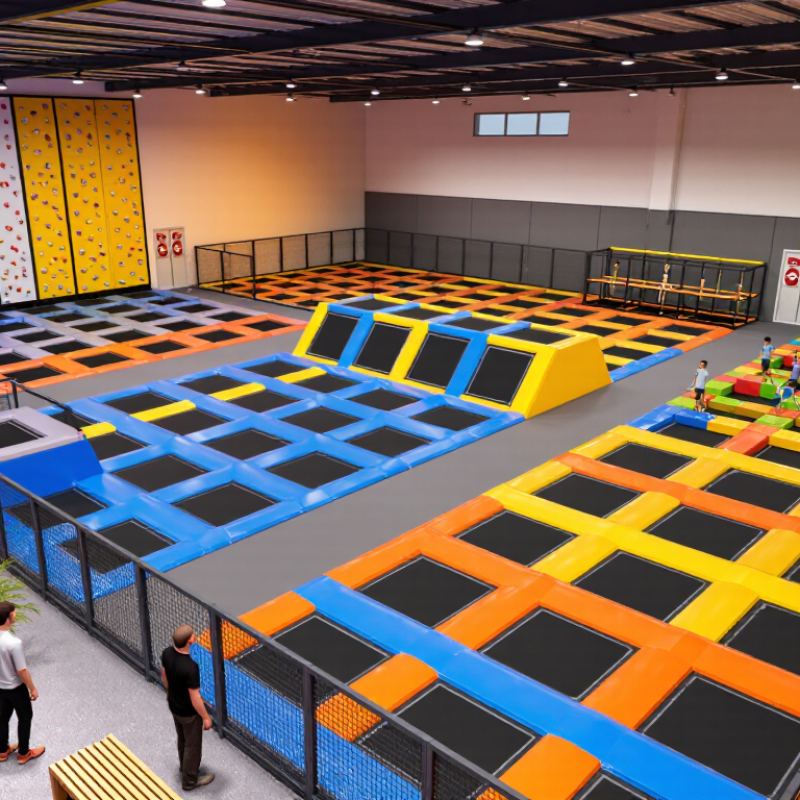
A China indoor trampoline park design manufacturer combines planning, engineering, production, and installation in one service. It is more than an equipment supplier. Experienced teams study ceiling height, floor area, visitor flow, emergency access, and the building’s structural capacity. They then create 3D layouts, trampoline zones, foam pits, climbing features, and reception areas. Details matter.
IAAPA’s 2024 Global Economic Impact Report estimates that the global attractions sector supports 24.5 million jobs and generates about US$1.1 trillion in economic activity. This growth increases demand for safer, more efficient indoor entertainment spaces. A qualified Chinese manufacturer should provide material specifications, load calculations, inspection records, and maintenance guidance. ASTM F2970 is also a useful technical reference for trampoline court design and operation. However, imported drawings may not fully match local building or fire requirements. That gap matters.
IAAPA’s 2024 Global Economic Impact Report estimates that the global attractions sector supports 24.5 million jobs and generates about US$1.1 trillion in economic activity.
Tips: Request a complete design package, not only attractive renderings. Check walking distances, padding thickness, steel connections, ventilation, and cleaning access. Ask for project evidence and independent inspection procedures. A colorful layout can still create blind corners. No design is perfect. Careful review improves it.
Core Design Services and Manufacturing Capabilities
China Indoor Trampoline Park Design Manufacturer?
A professional design manufacturer connects creative planning with practical engineering. The process begins with site measurements, ceiling checks, and customer-flow analysis. Traffic matters. Designers then create 3D layouts for trampolines, climbing zones, dodgeball courts, and reception areas. Each zone needs clear circulation and suitable supervision points. Experienced engineers review structural loads, impact areas, emergency access, and maintenance space before production starts.
Manufacturing turns the approved plan into physical equipment. Steel frames are cut, welded, and finished according to controlled drawings. Jumping beds, springs, platforms, barriers, and protective padding require accurate dimensions. Small errors can create large problems during installation. Production teams inspect welds, fasteners, surface finishes, and padding density. Factory inspection follows documented checklists. Before shipment, components are labeled and matched with installation drawings.
Reliable service also includes technical communication after delivery. The manufacturer should provide assembly guidance, cleaning recommendations, replacement-part information, and inspection records. Clear documentation supports safer daily operation. No design is perfect. A layout may look impressive but feel crowded during peak hours. That weakness should be discussed honestly. Site feedback can improve spacing, queue control, and staff visibility. This practical review builds trust and produces a more dependable indoor trampoline park.
China Indoor Trampoline Park Design Manufacturer? - Core Design Services and Manufacturing Capabilities
| Capability Area | Core Services | Typical Deliverables | Key Technical Considerations |
|---|---|---|---|
| Concept Planning | Site assessment, user-flow planning, activity zoning, capacity planning, and preliminary budget coordination. | Concept layout, zoning diagram, preliminary equipment list, visitor-flow plan, and area allocation schedule. | Available floor area, ceiling height, structural constraints, emergency exits, accessibility, and local building requirements. |
| 3D Design and Visualization | 3D modeling, visual identity integration, lighting concepts, material selection, and customer-route visualization. | 3D renderings, color and material boards, elevation views, equipment positioning, and design revision packages. | Sightlines, supervision visibility, impact protection, cleanability, durability, and consistency between design drawings and fabricated components. |
| Engineering Documentation | Detailed layout development, connection planning, load coordination, installation planning, and technical review. | Dimensioned drawings, component schedules, installation drawings, anchoring details, and maintenance access requirements. | Final engineering should be reviewed against the project location, applicable standards, building structure, and requirements of qualified local professionals. |
| Trampoline Systems | Design and production of interconnected trampoline beds, angled trampolines, dodgeball areas, and jump platforms. | Steel frames, springs or elastic systems, jumping mats, edge padding, divider systems, and replacement-part lists. | Frame stability, mat tension, padding coverage, gap control, wear resistance, inspection access, and safe separation of activity zones. |
| Climbing and Adventure Features | Development of climbing walls, soft-play structures, obstacle elements, tunnels, platforms, and interactive activity modules. | Fabricated frames, climbing panels, handholds, protective padding, access stairs, barriers, and installation guides. | Fall zones, impact attenuation, height control, handhold security, entrapment prevention, and age-appropriate difficulty levels. |
| Steel and Metal Fabrication | Cutting, bending, welding, drilling, surface preparation, modular assembly, and dimensional quality control. | Structural frames, posts, platforms, brackets, guardrails, access components, and labeled installation kits. | Material traceability, weld quality, corrosion protection, tolerances, edge finishing, load paths, and transport-friendly modularity. |
| Soft Components and Upholstery | Manufacturing of protective cushions, foam obstacles, wall panels, landing mats, covers, and padded seating. | Cut foam parts, covered padding, zippered or secured covers, replacement covers, and color-coded component sets. | Flame performance, abrasion resistance, seam strength, surface cleanability, foam resilience, and protection of hard structural edges. |
| Electrical and Interactive Elements | Integration planning for lighting, scoring systems, audio, interactive games, counters, and low-voltage control equipment. | Equipment locations, cable-routing plans, control points, power schedules, user-interface locations, and commissioning checklists. | Electrical protection, cable security, ventilation, maintenance access, moisture exposure, emergency isolation, and compliance with local electrical codes. |
| Prototype and Quality Control | Prototype review, incoming-material checks, dimensional inspection, functional testing, surface inspection, and packing verification. | Inspection records, sample approvals, defect reports, correction actions, packing lists, and final quality documentation. | Testing criteria should cover structural integrity, padding coverage, moving parts, fasteners, finish quality, labeling, and completeness of shipped components. |
| Packaging and Logistics | Component numbering, export packaging, container loading plans, shipping documentation, and installation-sequence preparation. | Palletized or crated components, packing lists, assembly labels, loading diagrams, and document packages. | Protection against moisture and impact, efficient use of container space, weight distribution, lifting points, and easy identification on site. |
| Installation and After-Sales Support | Remote installation guidance, on-site coordination options, staff orientation, inspection routines, and spare-parts support. | Installation manuals, maintenance schedules, inspection checklists, spare-part recommendations, and operator training materials. | Routine inspections, replacement cycles, cleaning procedures, incident documentation, operator supervision, and periodic safety reviews. |
Key Equipment, Materials, and Safety Standards
A reliable China indoor trampoline park design manufacturer should treat equipment selection as a safety engineering task. Core equipment includes interconnected trampolines, foam pits, air cushions, climbing walls, balance beams, and controlled access gates. Frames need corrosion-resistant steel, while jumping beds require tested polypropylene or equivalent woven materials. Padding should use dense, closed-cell foam with durable, flame-resistant covers.
The U.S. Consumer Product Safety Commission has reported over 100,000 trampoline-related injuries annually in earlier NEISS analyses. That figure still deserves attention. ASTM F2970 covers design, installation, operation, maintenance, and inspection of trampoline courts. ASTM F355 testing can help verify impact attenuation for protective surfaces. In Europe, EN 1176 principles may also influence playground components. These standards do not replace site-specific risk assessment.
Practical design matters. A 50-millimeter gap can trap fingers. Poorly anchored pads may expose steel edges after repeated use. Manufacturers should provide load calculations, material certificates, cleaning procedures, and documented inspection schedules. Operators also need visible rules, trained supervisors, emergency access, and daily checks of seams, springs, anchors, and foam-pit depth. I have seen attractive layouts fail because evacuation routes were treated as decoration. That mistake is easy to repeat. Safety records, third-party testing, and installation experience deserve more weight than colorful renderings.
The Design and Production Process from Concept to Installation
China Indoor Trampoline Park Design Manufacturer?
The Design and Production Process from Concept to Installation
A successful indoor trampoline park begins with a practical site survey. Our design team checks ceiling height, floor structure, entrances, fire exits, and visitor flow. Measurements are recorded carefully. Even small errors can affect installation.
The concept then becomes a detailed layout with trampolines, climbing walls, foam pits, soft-play zones, and reception areas. CAD drawings show safety clearances and maintenance access. Engineers review impact zones, anchor points, protective padding, and material strength. We select durable steel, impact-resistant foam, fire-rated fabrics, and non-slip surfaces. The design must feel exciting, not crowded. Some early concepts look impressive but create difficult supervision areas. We revise them.
Production follows approved drawings and documented quality checks. Components are cut, welded, padded, labeled, and assembled in stages. Factory staff inspect welds, stitching, spring tension, and connection points. A trial assembly can reveal problems that drawings miss. It is not always convenient, but it prevents costly changes later.
Before shipment, each module is checked against the packing list and installation plan. The installation team prepares the floor, follows numbered components, and verifies every anchor and protective edge. Local building and safety requirements must guide the final work. Staff training covers daily inspections, cleaning, emergency access, and visitor control. Handover documents include maintenance schedules and replacement guidance. Real projects rarely follow the original concept perfectly. Good communication keeps those changes controlled.
How to Select the Right Manufacturer for Your Project
China Indoor Trampoline Park Design Manufacturer? How to Select the Right Manufacturer for Your Project
Selecting a Chinese indoor trampoline park manufacturer requires more than comparing quotations. Grand View Research estimates that the global trampoline park market will continue expanding through 2030, increasing pressure on suppliers to deliver quickly. Growth is useful, but speed can hide weak planning. Ask for completed project evidence, structural drawings, load calculations, and maintenance records. A serious manufacturer should explain why each material suits your ceiling height, visitor flow, and local climate.
Safety documentation deserves close inspection. ASTM F2970 addresses trampoline court design, installation, operation, and maintenance, while EN 1176 provides broader playground safety guidance. These standards do not replace local approval. Request test reports for padding, springs, steel frames, flame resistance, and flooring. Check whether reports match the proposed materials, not an older product. Small detail. It matters.
Walk through the design like a visitor. Can staff see every court from the control desk? Is there a clear route from reception to lockers, then to jumping zones? Ask how often padding must be inspected and how damaged parts are replaced. The International Association of Amusement Parks and Attractions reported strong global visitor spending recovery after 2022, but attendance alone cannot prove quality. I have seen attractive renderings conceal crowded circulation areas. That mistake is expensive. Compare at least three factories, verify references independently, and keep installation, training, spare parts, and warranty terms in the contract. A low initial price may become a high operating cost.
